

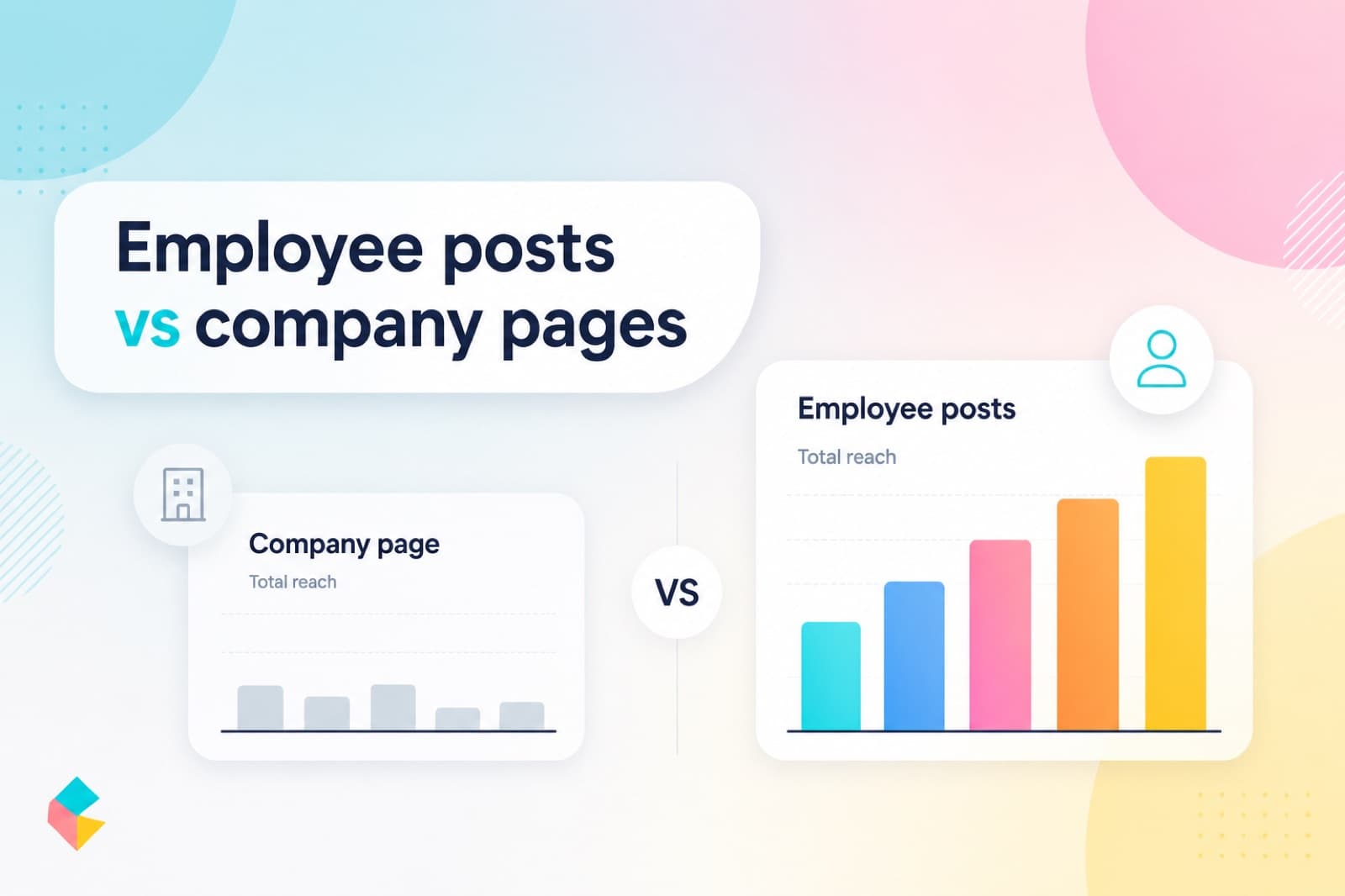
Most B2B teams still treat the company page as the “main” LinkedIn channel and employee posts as optional amplification.
The 2026 data says that’s backwards.
If you want a usable LinkedIn reach benchmark for employee posts vs. company pages, you need more than one viral anecdote. You need the pattern across impressions, engagement, comments, and shares, then a clear read on what each channel is actually good for.
The 2026 LinkedIn reach benchmark in one line
Personal profiles win the conversation. Company pages win the redistribution.
That sounds neat in a slide. Here’s what it means in numbers.
Metricool’s 2026 LinkedIn Study analyzed 673,658 posts across 63,108 accounts and compared Company Pages with Personal Profiles for the first time in their research. The headline gap:
- Personal profiles average about 2.60% engagement
- Company pages average about 1.60% engagement
- That’s roughly 63% higher engagement for individual voices
Average impressions per post look similar at the top line. The gap shows up in what happens after the impression: people comment on people, and they share brands.
Reach isn’t one number (and that’s where teams get confused)
Marketers say “reach” when they mean three different things:
- Impressions - how many times the post showed up
- Engagement rate - how often people interacted relative to those impressions
- Network expansion - whether the content left your existing follower bubble
Employee posts and company pages trade wins across those layers.
Where employee posts pull ahead
Below 10K followers, personal profiles tend to outperform company pages on impressions, comments, and engagement combined. That’s the operating reality for most startups and mid-market teams: your page is not a mega-publisher, but your people already sit inside buyer networks.
A few more 2026 signals that matter:
- Personal profiles generate 238% more comments per post than company pages
- Individuals post more often (~3.05x/week vs ~2.34x/week for pages)
- On personal profiles, nearly 40% of interactions land on day one, and about half of a post’s lifetime impressions happen in the first 48 hours
So the employee-side benchmark isn’t just “more reach.” It’s faster conversation density inside networks that already trust the poster.
Where company pages still matter
Company pages get shared dramatically more, up to about 15–17x depending on the cut of the data. That makes the page useful as a credibility home and redistribution layer, not as your only organic engine.
There’s also a weird-but-important format split:
- On company pages, posts with links see about +51% impressions and +41% interactions
- On personal profiles, links tend to hurt (~-27% impressions, ~-20% interactions)
Basically: send people to the gated guide from the page. On employee profiles, make the post valuable on its own first.
The classic advocacy multipliers still belong in the benchmark
The Metricool comparison is about profile type performance. Classic employee advocacy benchmarks still answer a different question: what happens when employees distribute brand content into their networks?
Those widely cited multipliers remain useful directional anchors:
- Employee-shared content is often associated with roughly 561% greater reach than brand channels alone
- Employee shares can drive about 8x more engagement than the same content from the brand
- Brand messages get re-shared ~24x more when employees distribute them
Treat those as program-level outcomes, not a promise that one reshare from an inactive seller beats your page forever. For the broader stats stack, see our roundup of employee advocacy LinkedIn statistics.
A simple way to read “employee posts vs company pages” in 2026
| Benchmark | Employee / personal posts | Company page |
|---|---|---|
| Engagement rate | ~2.60% (higher) | ~1.60% |
| Comments | Much stronger (~238% more) | Weaker conversation |
| Shares | Lower | Much higher (~15–17x) |
| Best job | Start trust + conversation in buyer networks | Amplify, host, redistribute |
| Links in posts | Often suppress performance | Often improve performance |
| Best first move for most B2B teams | Activate people | Support, don’t carry |
If your dashboard only tracks page impressions, you’re optimizing the weaker half of the system.
What a healthy LinkedIn reach mix looks like
You don’t need to kill the company page. You need to stop asking it to do employee work.
A practical 2026 operating model:
- Employees create the first wave. Insights, opinions, customer lessons, point-of-view posts. No link-dumping.
- The page reinforces and packages. Recap threads, product proof, hiring, links to assets, and polished brand statements.
- Sales and experts carry the highest-ROI reach. Their networks are closer to pipeline than a generic follower list.
- Measure participation, then reach quality. A steady base of posters beats three founders carrying the brand.
For the motion itself, start with employee advocacy. If revenue teams are the wedge, use LinkedIn advocacy for sales teams.
How to benchmark your own LinkedIn reach (without fake precision)
Industry numbers are useful for getting budget. Your internal benchmark is what changes behavior.
Track a simple monthly scoreboard:
- % of target employees who posted at least once
- Median impressions per employee post vs median page post
- Comments per post (employee vs page)
- Inbound DMs / profile views influenced for sellers who post consistently
- Content with vs without links, split by channel
Don’t obsess over matching the 63% engagement gap exactly. Obsess over whether employee networks are doing work your page structurally cannot: showing up in feeds of people who never followed the brand.
Bottom line
The 2026 LinkedIn reach benchmark is pretty blunt: employee posts outperform company pages where trust and conversation matter, while pages still help content travel through shares and branded distribution.
If your LinkedIn strategy is “post more from the company page,” you’re optimizing the channel that under-indexes on engagement. If your strategy is “make it easy for the whole company to show up,” you’re playing the side of the benchmark that compounds.
Want that motion without the blank-page friction? Book a demo and see how Empanada helps teams post like LinkedIn is an actual channel, not a chore.